
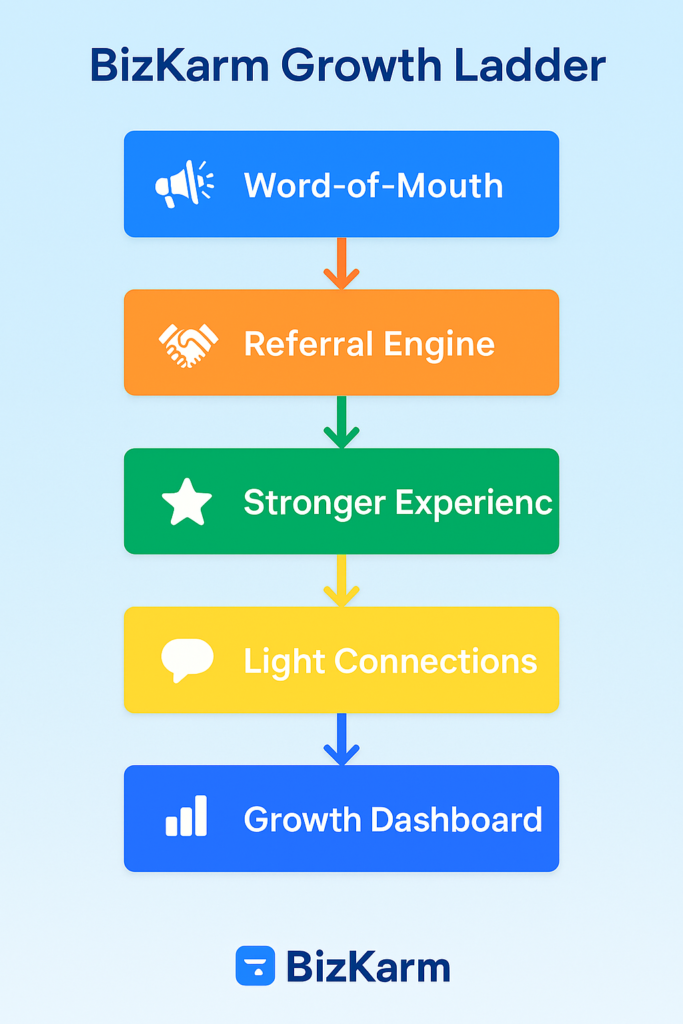
Most small business owners stop at the buzz. The ones that grow consistently take one more step.
📖 Prefer to read this in Hindi or your regional language? Use the GTranslate widget at the top of this page to switch languages instantly.
Every small business owner loves the moment a new customer says: “My friend told me about you.”
Word-of-mouth feels like validation. And it is. But here’s what most business owners don’t realize until it’s too late:
Word-of-mouth is not a strategy. It’s a signal.
It tells you that your product or service is good enough to talk about. What it doesn’t do — on its own — is guarantee that tomorrow’s customer will find you, or that next month’s revenue will be predictable.
That’s the gap this article is going to help you close.
The Honest Truth About Word-of-Mouth
Think about the small businesses you admire in your city. The chai stall that always has a line. The tailor everyone in the neighbourhood recommends. The salon that books out weeks in advance.
Yes, they have great word-of-mouth. But look more closely and you’ll see something else: they have systems.
They do something intentional to keep customers coming back. They make it easy to refer a friend. They stay connected between visits. They show up consistently — online or offline — so they’re never forgotten.
Word-of-mouth got them noticed. Systems made them sustainable.
Here’s the progression that separates businesses that grow from businesses that plateau:
Word-of-Mouth → Referral Engine → Stronger Experience → Social Proof → Customer Connections → Partnerships → Growth Dashboard
Let’s walk through each step.
Step 1: Turn Word-of-Mouth Into a Referral Engine
Word-of-mouth is unpredictable. A referral system makes it intentional.
The difference is simple: instead of hoping a happy customer tells a friend, you ask them to — and you make it worth their while.
What this looks like in practice:
- Offer a simple reward for referrals — a discount, a free add-on, or loyalty points
- Give customers a referral card, a QR code, or a shareable link
- Ask at the right moment — right after a positive review, a repeat visit, or a completed service
- Track how many referrals are actually converting each month
Real example: A small café in Austin introduced a “Bring a Friend, Get a Free Pastry” card. Within 60 days, 42% of customers brought someone new, daily foot traffic increased by 28%, and their Google reviews nearly doubled. They didn’t change anything about their food. They changed their system.
Step 2: Strengthen the Experience So Customers Want to Refer You
Referrals are a symptom of a great experience. If you want more referrals, invest in the experience first.
This doesn’t mean a full renovation or a new menu. It means finding the friction points that quietly frustrate customers and removing them — then adding one moment of unexpected warmth.
Simple moves that make a difference:
- Fix the top two or three friction points your customers mention most
- Add one “delight moment” — a handwritten thank-you note, a small freebie, a personalised follow-up message
- Standardise how your service is delivered so every customer gets a consistent experience
- Ask customers a single satisfaction question every few months so you know where you stand
Real example: A barber in Toronto added just two touches — a warm towel finish and a personalised text reminder before each appointment. Within a year he had a three-week waitlist. The cost per customer: less than ₹80.
Step 3: Turn Private Praise Into Public Credibility
Your happy customers are talking about you privately. Your job is to make some of that praise visible.
Social proof — reviews, testimonials, customer stories — does the convincing for you before a new customer has even spoken to you.
What to do:
- Ask every satisfied customer for a Google review (most will say yes if you simply ask)
- Collect short video testimonials on your phone — even 30 seconds is powerful
- Share customer stories on social media with their permission
- Create a “Results” or “Customer Stories” section on your BizKarm profile so new visitors can see real experiences right away
Real example: A home baker in Mumbai started posting before-and-after photos of her cakes along with short customer reactions. One reel hit 200,000 views. Her orders tripled in three months — not because she baked differently, but because she made her results visible.
Step 4: Build Lightweight Connections With Your Customers
You don’t need a Facebook group or a Discord server. You need simple, consistent touchpoints that keep you in your customer’s mind between visits.
The goal isn’t community management. The goal is staying present.
Easy ways to stay connected:
- Send a monthly update to your customers — one useful tip, one business update, one offer
- Create a VIP list for early access to new products or seasonal offers
- Respond to every comment or review within 24 hours
- Use BizKarm to send direct messages and updates to your subscribers — customers who have already opted in to hear from you, so your messages feel welcome rather than intrusive
Real example: A small yoga studio in Boston created a WhatsApp broadcast list for class updates, mini challenges, and wellness tips. It wasn’t a community — it was a connection channel. Their customer retention jumped from 72% to 90%.
Step 5: Build Partnerships That Multiply Your Reach
Your word-of-mouth reaches your existing customers. Partnerships reach everyone else.
Find two or three complementary businesses that serve the same type of customer — but don’t compete with you — and explore simple ways to cross-promote each other.
What this can look like:
- A boutique and a salon offering a “Look Good, Feel Good” weekend package
- A gym and a nutrition store running a joint referral programme
- A photography studio and a wedding planner recommending each other to every enquiry
Real example: A florist and a café in Chicago created a “Coffee + Flowers” weekend bundle. Both businesses saw a 22% increase in weekend sales and dozens of new customers discovering each business through the other.
Partnerships are the fastest way to borrow trust you haven’t yet earned.
Step 6: Track What’s Working
You cannot improve what you don’t measure. And you don’t need complex analytics — you need four or five numbers, checked once a month.
Track these:
- How many referrals came in this month?
- How many of those converted into paying customers?
- What percentage of customers came back for a second visit?
- How many new reviews did you receive?
- What did it cost you to acquire each new customer?
These five numbers will tell you more about the health of your business than any complicated report.
How BizKarm Fits Into This System
BizKarm was built specifically to help small businesses execute steps like these — without a marketing team, without a big budget, and without technical complexity.
With BizKarm you can:
- Send direct messages and updates to customers who have subscribed to your business
- Share coupons and loyalty rewards to encourage repeat visits and referrals
- Build a digital presence that new customers can find and trust
- Stay connected with your customer base between visits — so you’re never out of sight, out of mind
Whether you run a salon, a restaurant, a repair shop, or a retail store — BizKarm gives you the tools to turn word-of-mouth into a system.
👉 Get started free at BizKarm India or BizKarm USA
The Simple Shift That Changes Everything
The businesses that grow the fastest after word-of-mouth aren’t the ones with the biggest buzz.
They’re the ones that asked one question their competitors never thought to ask:
“Now that people are talking about us — what do we do next?”
Now you have the answer.
This article is part of a series on practical, zero-cost growth strategies for small business owners. Read the full series on Substack at nitin4businesses.substack.com — new articles every week covering word-of-mouth, referral systems, customer retention, and more.